You hit your salary target. You booked the promotion. The bank balance looks lovely. Yet somewhere between the meetings and the grocery list, a small voice asks, “Is this it?” You’re in good company if you recognise that voice. Many women reach every financial milestone and still feel oddly empty. Nobody warned them that a full account and a full heart are two separate things.
Society hands women one scorecard, and it counts only money. That scorecard ignores confidence, peace of mind, healthy boundaries, and a sense of purpose. Ignore those long enough, and burnout moves-in quietly. Relationships suffer. Identity fades into job titles and family roles.
This guide challenges the belief that financial success is the final proof of a good life. You will learn what the research says, which quiet wins women overlook, and how women’s empowerment coaching helps you redefine success on your own terms. Keep reading. Your next goal might not have a price tag.
Why Does Society Judge a Woman’s Success by Her Salary?
Money is easy to count. That is the whole secret. A salary fits on a payslip, a promotion fits on a visiting card, and a net worth fits into small talk at a wedding buffet. Confidence, peace, and purpose do not. So people measure what they can see, and women inherit that habit early.
Here is the unfair part. Women receive the same scorecard as men but run a steeper track. In the Global Gender Gap Report 2026 by the World Economic Forum, India closed 64.5% of its overall gender gap and ranked 131st among 145 economies. Its Economic Participation and Opportunity score stood at 41.2%, and its educational attainment score stood at 96.6%. The report also puts India’s estimated earned income parity at 35.1%.
These are gender parity index scores on a 0 to 100% scale, where 100% means women and men are equal. They are not the percentage of women who earn the same as men, and they are not the conventional gender pay gap. The earned income score compares the economic resources earned by women with those earned by men. It relies on modelled data that reflects both pay and how many women work. Even so, the pattern is clear. Education scores sit near parity, yet the economic scores stay far lower.
So, is money the only measure of success for a woman? No. It also fails as a fair measure. If the scoreboard itself tilts, a lower number says little about a woman’s worth, effort, or talent. Differences in pay, access to paid work, and unpaid care duties can distort the score before she even plays. Judging yourself by a rigged scoreboard is a sure way to feel behind.
Can a Big Paycheck Alone Make a Woman Feel Successful?
Money helps. Let us be honest about that. Rent, school fees, medical bills, and a decent holiday all need cash, and financial independence gives a woman real choices. A 2023 paper in a leading science journal, titled Income and Emotional Well-Being: A Conflict Resolved (Killingsworth, Kahneman, and Mellers, PNAS), analyzed experience sampling data again to settle an old debate. It found that happiness rose steadily with income among happier people and even sped up in the happiest group. The flattening pattern appeared only in the least happy group, about the bottom 20% of respondents. The study shows an association between income and reported happiness. It does not prove that money causes joy, and it does not describe every person. Money is a tool, not a verdict.
Now look at working women. A March 2026 thematic review of earlier Indian studies (Medda and Ali, International Journal of Indian Psychology) notes that paid work brings financial independence and self fulfilment, yet in many cases adds mental pressure through the double burden of work and family duties. It also points out that results are mixed and that studies often focus on urban, middle-class professionals. A 2024 survey by a mental health platform (YourDost, Emotional Wellness State of Employees) covered over 5,000 Indian professionals. Among those respondents, 72.2% of women reported high stress, against 53.64% of men. Also, 20% of women said they always feel down, compared with 9.27% of men. These findings describe the surveyed professionals, not all working women in India.
Does more money fix emotional burnout? Not always, and it depends on the person. Money can ease pressures like bills and childcare costs. Emotional burnout also tends to need rest, boundaries, and meaning, which a bonus cheque cannot buy on its own. Poor work life balance and low mental wellbeing can sit comfortably next to a big salary.
What Quiet Wins Do Women Often Overlook?
Some of the biggest wins never reach a social media post. Nobody throws a party when you stop apologizing for a reasonable request. Yet these quiet wins shape your whole life, and they deserve a place on your scorecard.
Rebuilding Confidence and Self Worth
Think about the day you spoke up in a meeting after months of silence. That counts. Confidence building rarely looks dramatic. It looks like saying “I disagree” without rehearsing it twelve times in the shower. A stronger sense of self-worth also shows up in how a woman asks for fair pay and prices her work. So, this quiet win can sometimes pay off financially too, which is a pleasant bonus rather than the goal.
Finding Emotional Independence and Healthy Boundaries
Emotional independence means your mood does not depend on everyone’s approval. You can disappoint someone and still sleep well. Healthy boundaries make that possible. A boundary is a polite, firm sentence such as “I cannot take this on today.” Many women learn to say yes first and resent later. Learning to say no is real personal growth, and it protects your energy, your time, and your relationships.
Reclaiming Identity and Purpose
Job titles, family roles, and labels like “someone’s mother” or “someone’s wife” can swallow a woman’s identity. Reclaiming it starts with asking what you value, what you enjoy, and what you want your days to feel like. Purposeful living does not demand a grand mission. A small purpose, like mentoring a junior colleague or finishing the painting you started in 2019, gives your week direction. That direction feels like success, even when the payslip stays the same.
How Does Unpaid Work Hide a Woman’s Real Contribution?
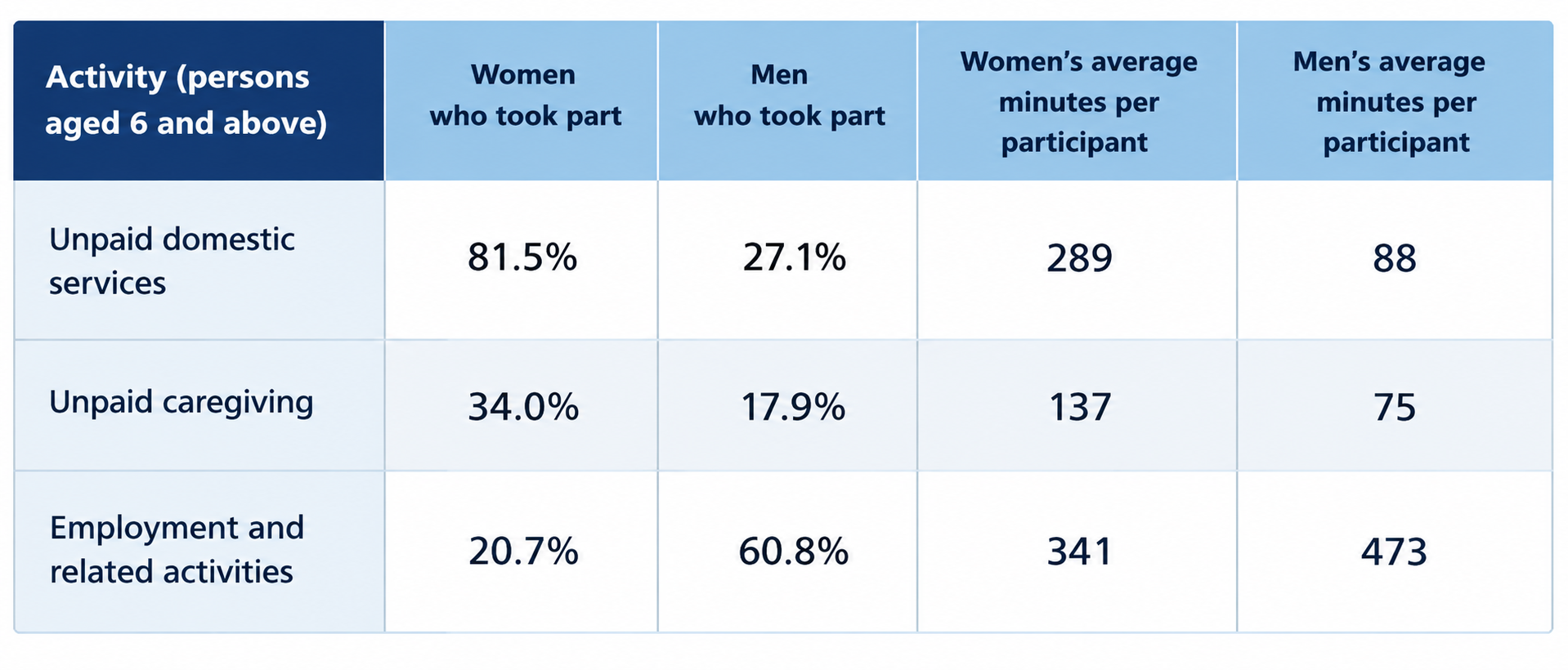
Money counts paid work only. Yet a large share of women’s effort never reaches a payslip. India’s Time Use Survey 2024, conducted by the National Statistics Office under MoSPI, shows how big that hidden share is. It covered persons aged six and above. On the day recorded, 81.5% of females did unpaid domestic work for their households, against 27.1% of males. Among those who did this work, women spent 289 minutes on average and men spent 88 minutes.
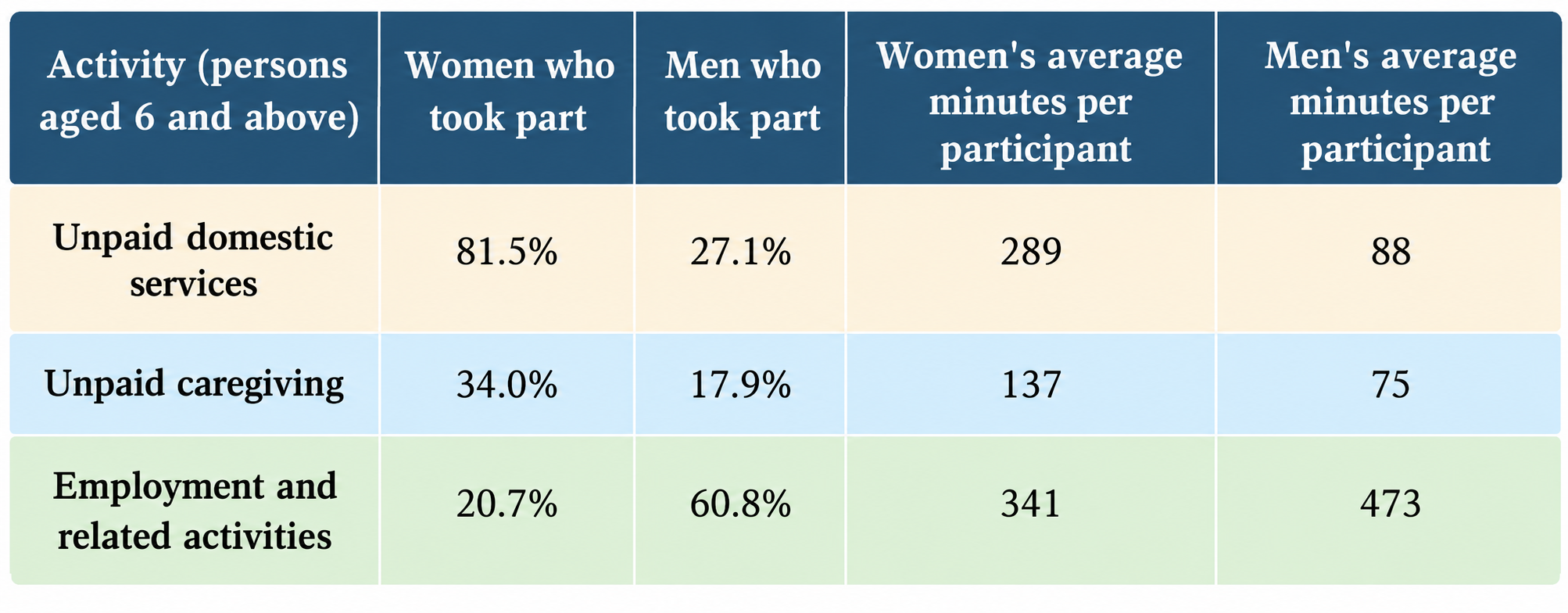
The table separates two ideas. Participation shows how many people did the activity. Minutes show the average time among those who did it, so they do not describe every woman and man. Averaged across all persons aged six and above, unpaid activities took 305 minutes a day for women and 56 minutes for men. Fewer women than men did employment on the day recorded, so the participant minutes for employment do not show women’s overall paid work time.
Is unpaid care work a form of success? It is certainly a form of contribution. It takes skill, patience, and planning. A woman who runs a household while holding a job manages logistics that would exhaust a project manager. No payslip records it. Women’s empowerment coaching helps women see this contribution, share the load, and stop measuring their worth against a paycheck that ignores it.
How Does Women’s Empowerment Coaching Redefine Success?
What is women’s empowerment coaching? It is a guided, one on one partnership between a woman and a trained life coach or women empowerment coach. The coach asks sharp questions, listens closely, and offers practical tools. She does not hand you a ready-made definition of success. She helps you write your own.
How does a life coach help with self-worth? She spots limiting beliefs, such as “I am not good enough for that role,” and helps you test whether they are true. A mindset shift can then replace old scripts with kinder and more accurate ones. A good coaching process usually includes these elements.
• Being clear about your priorities, values, and strengths
• Tools for effective communication at work and at home
• Support for inner clarity and emotional healing
• Goals that balance career, relationships, and wellbeing
Coaching focuses on goals, skills, and the road ahead. Counselling and therapy can also look at the present and the future, and they often explore emotional wounds and mental health conditions with clinical training. The two strategies can work well together. If you live with a diagnosed condition or lasting distress, please see a licensed professional too. Coaching can help many women build a life that feels right from the inside, though results differ by person, goals, and effort, and no coach can promise a specific outcome.
What Does Success Mean to You?
Start small. Grab a notebook and a cup of maybe masala chai or chamomile tea. Then work through these pointers.
• List five moments from the past year that made you proud, and note how many involved money.
• Write down how you would spend a free Saturday if nobody judged you.
• Name one boundary you need and one conversation you have avoided.
• Describe an ordinary day in the life you want, hour by hour.
• Pick one tiny action for this week.
How do I define success for myself? Look for patterns in your answers. They reveal your values, and those values become your personal scorecard. A career restart, a new hobby, a healed friendship, or a calmer morning can each earn a line on it. Can a woman be successful without a high income? Yes. Success measures the match between your values and your life, not the size of your bank statement. Keep earning goals on the list, since financial independence matters. Just give them company.
In Conclusion
The answer to the title question is no. Money is a useful measure, but it is not the best one. It buys choices, security, and comfort, and every woman deserves plenty of all three. Yet research shows that income and happiness do not move together for everyone, and a survey of Indian professionals found that women reported higher stress than men. Global parity scores show a tilted scoreboard in economic participation, and official time use data shows that women do far more unpaid domestic work than men.
Real success includes confidence, emotional independence, healthy boundaries, purpose, strong relationships, and a clear sense of identity. These quiet wins rarely make headlines. They make life feel worth living. Women’s empowerment coaching helps you notice them, build them, and measure your life by your own values.
You do not need to abandon ambition. You need to widen the scorecard. Add peace, purpose, and joy next to the salary line. Then let your life look successful because it feels successful.
Are You Prepared to Create a Successful Life? Begin With Soul Sakhi
Soul Sakhi offers women’s empowerment coaching led by Sangita, a communication enhancer and life coach with more than 17 years of experience in multinational workplaces. She knows burnout personally. After corporate leadership roles and the demands of motherhood, she chose self-rediscovery over stagnation. Today she guides women back to their power, identity, and purpose.
Her one-on-one sessions cover confidence and self-worth, mindset realignment, conscious communication, emotional healing, identity alignment, and life direction. Every session is personal, practical, and free of judgement. You don’t need to have a flawless plan. You need willingness to begin.
This work suits you if you feel stuck or directionless, if midlife stagnation or burnout has crept in, if confidence or communication holds you back, or if you want to reclaim your identity, whether you work outside the home or not.
Take the first step today. Book a discovery call at https://soulsakhi.co.in, message Soul Sakhi on WhatsApp at 9972467890, or write to info@soulsakhi.co.in. Your life should feel successful to you, and that conversation can start this week.
Frequently Asked Questions
1. What is women’s empowerment coaching?
It is a one-on-one process where a trained coach helps a woman build confidence, clarity, and direction. Together they identify limiting beliefs, set personal goals, and create practical steps for a life that matches her values.
2. Is money the only measure of success for a woman?
No. Money gives security and choice, but success also includes confidence, healthy relationships, emotional wellbeing, purpose, and identity. Each woman should weigh these elements according to her own values.
3. Can a woman feel successful without a high income?
Yes. Success depends on alignment between your values and your daily life. Many women feel deeply successful through stable relationships, meaningful work, good health, and personal growth, even with modest earnings.
4. How does a life coach differ from a counsellor?
A life coach focuses on goals, skills, and moving forward. A counsellor or therapist has clinical training and can also support emotional healing, past experiences, and mental health conditions. Many people find the two complement each other.
5. How soon can a woman see results from coaching?
There is no fixed timeline. Some women report feeling clearer within a few sessions, while others need longer. Results depend on your goals, effort, and fit with your coach, and no coach can guarantee a specific outcome.